Android Backup Instructions
Want to export your own text messages to PDF?
If you're looking to generate PDFs of your own text message conversations, you can do it directly on your Android phone with TextExhibit Android App. No backup file creation, no desktop app, and no computer required.
If you need to create a text message backup file to use with TextExhibit on a computer, follow the instructions below.
This guide explains how to export your text messages from an Android phone as an XML backup file for use with TextExhibit.
Overview
You will use a free app called SMS Backup & Restore to export your text messages to an XML file. This file contains all your SMS and MMS messages, including any photos or videos.
Step 1: Install SMS Backup & Restore
Download and install the SMS Backup & Restore app from the Google Play Store:

Note: This is a free, well established app. You do not need to purchase any premium features for this process.
Step 2: Create a Backup
- Open the SMS Backup & Restore app
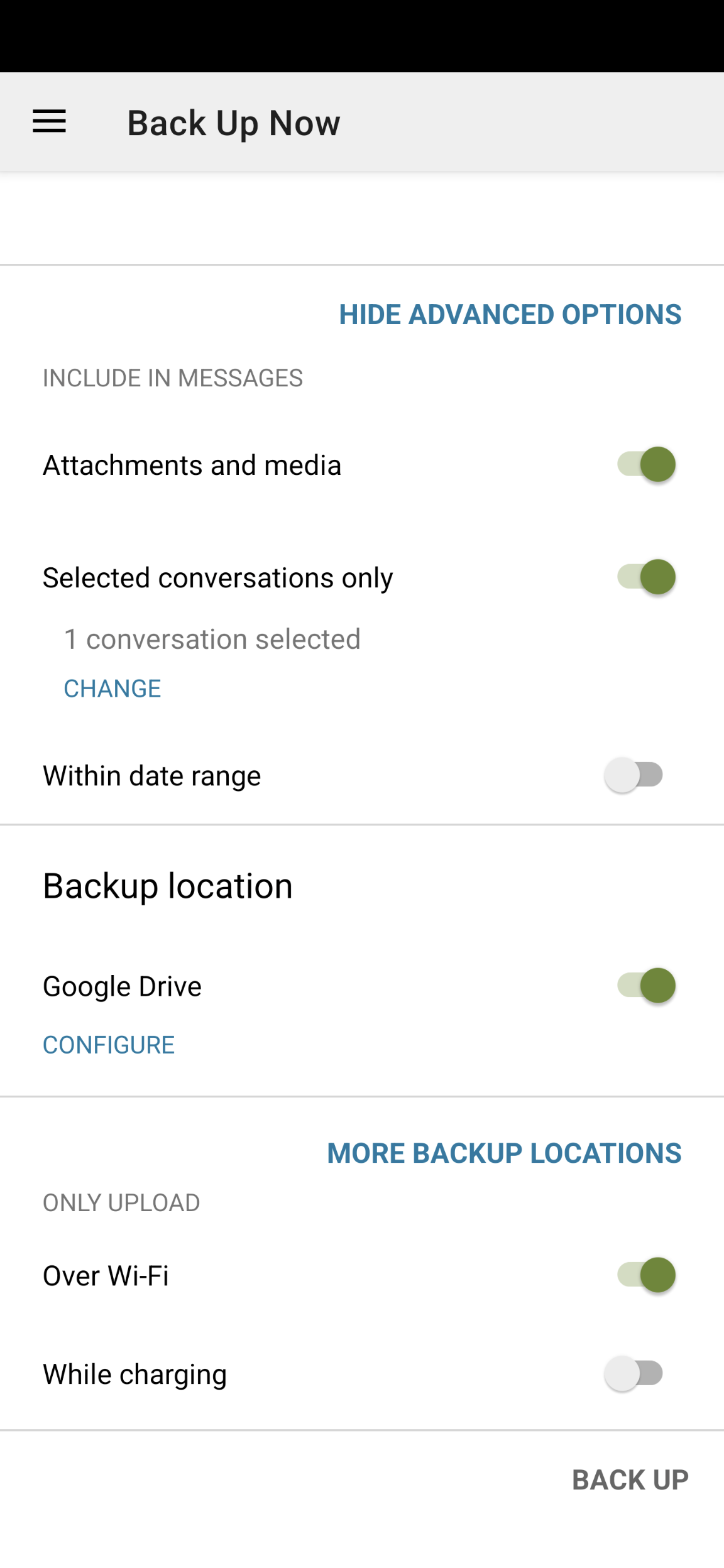
- Tap “Back Up Now” (you may have to tap on the three horizontal lines first)
- Tap “Advanced Options”
- Attachments and media - Required
- Selected Conversations only - Enable this, and then select which conversations to export
- Within date range - Optional, this can also be filtered later in TextExhibit, but if you know the relevant date range you may set it now.
- Choose where to save the backup:
- Google Drive we recommend uploading the backup XML file to Google Drive so it is easy to find/download on a PC or Mac
- Your Phone SMS Backup and Restore should also save the XML backup file to your phone by default
- Tap “Back Up”
- Wait for the backup to complete
Step 3: Download the Backup XML File
After the backup completes, you need to find the XML file:
- Log into Google Drive
- Look for a file named similar to:
sms-YYYYMMDDHHMMSS.xml- Example:
sms-20250115143022.xml - Search for sms xml if you don’t see it in the recent files
- Example:
- Click the three vertical dots to the right of the filename, then click Download
Important: If you backed up MMS messages, there may also be an mms-YYYYMMDDHHMMSS.xml file. Download both files.
Step 4: Use or Share the Backup File
If you’re processing the messages yourself, open the XML file in TextExhibit — see Using TextExhibit for next steps.
If you’re sending the backup to someone else, they should be able to give you instructions on how to securely deliver the XML file — this may involve a SharePoint upload link or sharing via Google Drive.
Optional: Device Information
If you need the device name and serial number to appear in the PDF footer, this information must be provided manually.
The device name and serial number may be needed for documentation purposes to appear in the PDF footer. To find this:
- Open Settings on your phone
- Scroll down and tap About Phone (or About Device)
- Look for:
- Device name (or Model name)
- Serial number
- Long press on the Device name and then press Copy
- Tap on Model
- Long press on Serial number, and then press Copy
Note: Android apps cannot access the device serial number directly for security reasons. This information must be provided manually.
Troubleshooting
The backup file is very large
Large backup files (over 25MB) may be too big to email. Use a cloud storage service like Google Drive to share the file instead.
The app asks for permissions
SMS Backup & Restore needs permission to access your messages. Grant the requested permissions to proceed.
Next Steps
Once the backup file is ready, load it into TextExhibit to convert your messages into court-ready PDF documents. See Using TextExhibit for next steps.